CRO vs. SEO: Which Should You Focus on in 2026?
· Editorial Team

If you've got limited budget and you're trying to decide between conversion rate optimization (CRO) and search engine optimization (SEO), here's the short answer: it's rarely an either/or choice, but if you had to pick a starting point, it usually comes down to one question — do you have enough traffic to test on, or not?
SEO brings people to your site. CRO turns more of those people into customers, subscribers, or leads. Treating them as competing budget lines is one of the more expensive mistakes a growing business can make, because each one makes the other more valuable. A site ranking on page one with a 0.8% conversion rate is leaving money on the table just as badly as a beautifully optimized landing page that nobody ever finds.
This article breaks down what each discipline actually does, where they genuinely differ, when to prioritize one over the other, and why more businesses — and more SEO agencies themselves — are folding CRO into their strategy as a default rather than an add-on. We'll also cover realistic costs, timelines, and the specific scenarios where hiring a team that handles SEO and CRO together outperforms hiring two separate specialists.
What Is CRO in Marketing?
Conversion rate optimization is the structured process of increasing the percentage of website visitors who complete a specific, defined action — buying a product, requesting a demo, filling out a form, starting a free trial. It's not redesigning a page because it "looks dated." It's forming a hypothesis based on user behavior data, testing a specific change against the current version, and keeping only what measurably performs better.
A typical CRO cycle looks like this:
- Audit — Pull analytics, session recordings, and heatmaps to find where visitors drop off.
- Research — Understand why they're dropping off (confusing copy, slow load time, unclear CTA, trust gaps, too many form fields).
- Hypothesize — Form a specific, testable prediction ("Moving the pricing table above the fold will increase demo requests").
- Test — Run an A/B or multivariate test against a large enough sample to be statistically meaningful.
- Implement or discard — Roll out the winner, kill the loser, and move to the next bottleneck.
The math behind CRO is straightforward and it's why it gets attention even from teams that don't think of themselves as "marketing people": if a site gets 5,000 monthly visitors converting at 1%, that's 50 conversions. Raise the rate to 2% and you get 100 conversions — without spending another dollar acquiring traffic. That's the entire value proposition in one sentence: CRO compounds the return on marketing spend you've already committed.
Industry benchmarks vary a lot by sector, but most websites convert somewhere in the 2–3% range, while top-performing pages in the same categories reach into the double digits. That gap is almost always closed through better structure and testing, not through more traffic.
What Is SEO?
Search engine optimization is the practice of improving a website so it ranks higher in organic (unpaid) search results for the terms your target customers actually search. It covers three broad areas:
- Technical SEO — site speed, crawlability, mobile-friendliness, structured data, indexation.
- On-page SEO — content quality, keyword and topic relevance, internal linking, title tags, header structure.
- Off-page SEO — backlinks, brand mentions, and other trust/authority signals from outside your own site.
SEO's job is demand capture and, increasingly, demand generation through content that answers questions before a purchase decision is even made. Where CRO asks "how do we get more out of the traffic we already have," SEO asks "how do we get found by the traffic that's already searching for what we offer."
CRO vs. SEO: The Core Differences
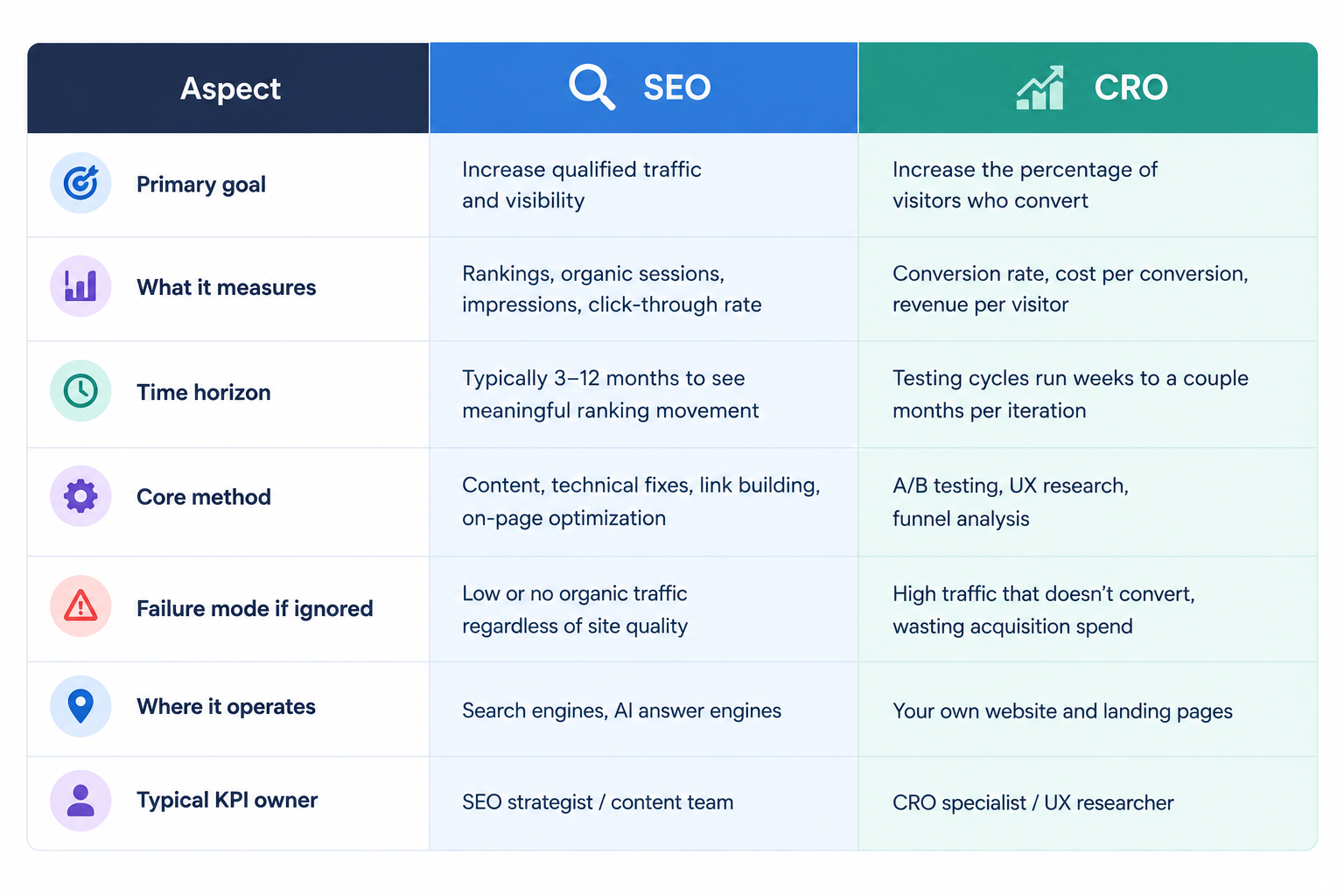
The two disciplines answer different questions, which is exactly why comparing them as "SEO vs CRO" and expecting one clear winner misses the point. A business with zero traffic doesn't have anything for a CRO program to test. A business with strong traffic and a weak conversion rate doesn't need more visitors — it needs a better experience for the ones it already has.
Why "SEO vs. CRO" Is the Wrong Framing
Here's where the two disciplines actually connect, and it's more concrete than "they work well together":
Search Engines Increasingly Reward Pages That Convert.
Google's algorithms track user engagement signals — how long people stay, whether they bounce straight back to the results page, whether they complete an action. A page that ranks well but converts poorly often also struggles to hold its ranking, because those weak engagement signals feed back into how search engines evaluate the page over time. CRO improvements — clearer structure, faster load times, more relevant content matching search intent — directly overlap with what makes a page rank well in the first place.
Seo Traffic Is Expensive To Earn And Easy To Waste.
Ranking on page one for a competitive commercial keyword can take months of consistent content and technical work. If the landing page that traffic lands on has a confusing CTA or a five-field contact form that scares off mobile users, you're paying the full cost of SEO and collecting only a fraction of the return.
Cro Data Improves Seo Content.
Session recordings and on-site search data from CRO research reveal the actual questions and objections visitors have — which are often better keyword and content ideas than a keyword research tool alone would surface.
In practice, the highest-performing marketing programs treat SEO and CRO as one continuous loop: SEO brings in the right people, CRO makes sure the page does its job once they arrive, and the resulting behavior data feeds the next round of SEO content decisions.
Why CRO Matters More for SEO Agencies Right Now
This is the part of the conversation that's changed the most heading into 2026, and it's the reason "why conversational conversion optimization matters for SEO agencies" is becoming a real question inside marketing teams rather than a niche one.
AI Overviews and AI-powered search experiences are changing what happens before a visitor even reaches your site. Multiple 2025–2026 industry analyses — including Ahrefs' study of roughly 300,000 keywords — found that when an AI Overview appears above the traditional results, click-through rate for the number-one organic position drops sharply, in some measurements by more than half compared to searches without an AI Overview present. Other large-panel studies from SparkToro and Similarweb put the overall share of Google searches ending without any click at somewhere around 60%, and considerably higher on mobile.
What this means practically: ranking well is no longer a reliable proxy for getting traffic the way it was a few years ago. Fewer searches convert into clicks at all, which makes the clicks that do arrive at your site meaningfully more valuable — and it raises the cost of a weak landing page. An SEO agency that only delivers rankings, without also improving what happens after the click, is increasingly delivering an incomplete result. This is the practical reason CRO is shifting from an optional upsell to a core part of what a competent SEO agency should offer.
There's a flip side worth noting too, based on early data from several of these same studies: visitors who arrive from AI-generated answers and citations tend to convert at meaningfully higher rates than average organic visitors, likely because the AI system has already done some of the qualifying work before the click happens. That makes the design of the landing page these visitors land on — clear, fast, trustworthy, easy to act on — even more consequential, not less.
Which Should You Prioritize First? A Decision Framework
There's no universal answer, but your current numbers point you in a direction. Use this as a starting filter:
Prioritize SEO first if:
- You're getting under a few hundred monthly organic visitors — there isn't enough traffic yet to run statistically meaningful CRO tests.
- You're a new site or a recent rebrand with little to no organic visibility.
- Your paid traffic costs are climbing and you need a lower-cost, compounding acquisition channel.
Prioritize CRO first if:
- You have decent traffic (roughly 1,000+ monthly visitors to key pages) but a conversion rate that's clearly below your industry's typical range.
- You're spending significantly on paid ads or SEO already and the return doesn't match the traffic volume.
- You have a specific, high-value page — a pricing page, a demo request form, a checkout flow — with an unusually high drop-off point you can see in analytics.
Run both in parallel if:
- You have steady, moderate traffic and want compounding gains rather than a sequential fix.
- You're preparing for a bigger push (a product launch, a funding round, a seasonal push) and want both the funnel and the visibility working before that traffic arrives.
If you're genuinely unsure where you stand, an audit of your current analytics — traffic volume, conversion rate by channel, and top drop-off pages — usually answers the question in under an hour.
What Integrated SEO and CRO Strategy Looks Like in Practice
An SEO and CRO integration isn't just running both programs side by side. It means the two teams (or the same team) share data and decisions:
- Shared KPIs. Instead of "rankings" and "conversion rate" living in separate reports, both feed a single revenue or lead-generation metric.
- Content built for the whole journey, not just the click. A blog post targeting a commercial-intent keyword is written with the next step — a demo request, a product page, a lead magnet — designed in from the start, not bolted on afterward.
- Testing on high-traffic SEO pages first. The pages already earning organic visits are the best candidates for CRO testing, because they reach statistical significance faster.
- Behavioral data informing content updates. If session recordings show visitors repeatedly scrolling past a section looking for pricing or proof, that's a signal for both a CRO test and an SEO content update addressing that gap directly.
- Technical SEO and page speed treated as CRO issues too. A slow-loading page hurts rankings and tanks conversion rates simultaneously — fixing it serves both goals with one piece of work.
Relevant for readers whose CRO testing needs (landing page builds, A/B testing infrastructure, tracking setup) require dev work
Benefits of Hiring an SEO and CRO Agency Together
Splitting SEO and CRO across two separate vendors is common, but it creates a specific, recurring problem: neither vendor is accountable for the full outcome. The SEO agency can point to rankings and traffic growth even if conversions stay flat. The CRO agency can point to a lifted conversion rate on a page that's barely getting any traffic to begin with. Revenue — the number that actually matters to the business — sits in the gap between the two reports.
Hiring a team that handles SEO and CRO services together, or at minimum coordinates them closely, tends to produce a few concrete advantages:
- One accountable outcome. The team is measured on qualified traffic and what that traffic does, not one in isolation.
- Faster iteration. Behavioral data from CRO work informs the next content or technical SEO priority without a handoff delay between two separate teams.
- No wasted spend on ranking pages that don't convert. New content and landing pages are built with conversion structure from day one, rather than optimized for conversion months later.
- Consistent technical foundation. Site speed, mobile experience, and page structure improvements serve both disciplines instead of being prioritized twice under different budgets.
- Better reporting clarity. Leadership gets one funnel view — traffic in, conversions out — instead of reconciling two disconnected sets of metrics.
This is the model behind why an integrated SEO and CRO strategy is gaining ground with SaaS companies, ecommerce brands, and service businesses that need marketing spend to show up in revenue, not just traffic charts.
Common Mistakes Businesses Make Choosing Between SEO and CRO
- Treating CRO as a one-time project. A single round of A/B tests isn't a program. Conversion optimization works best as an ongoing loop, because what converts well today can plateau as your traffic mix, competitors, and audience expectations shift.
- Running SEO content with no conversion path. Ranking for a keyword with no clear next step for the visitor is a missed opportunity, not a win.
- Testing CRO changes on low-traffic pages. Without enough visitors, A/B test results aren't statistically reliable — you'll end up making decisions based on noise.
- Ignoring page speed and mobile experience as a shared problem. These affect rankings and conversions simultaneously, so fixing them separately under two budgets is inefficient.
- Judging SEO purely by rankings. In a search landscape where a growing share of queries end without a click, ranking position alone is an incomplete signal of whether the investment is paying off.
Frequently Asked Questions and Answers
1. What is CRO and SEO?
CRO (conversion rate optimization) is the process of increasing the percentage of website visitors who complete a specific action, like making a purchase or filling out a form. SEO (search engine optimization) is the process of improving a website's visibility in organic search results so more of the right people find it. SEO brings visitors in; CRO makes sure more of them convert once they arrive.
2. What does CRO mean in marketing?
In marketing, CRO refers to the systematic, data-driven process of improving how well a website or landing page turns visitors into customers, leads, or subscribers. It relies on analytics, user research, and A/B testing rather than guesswork or aesthetic preference, and it's typically measured by conversion rate, cost per conversion, and revenue per visitor.
3. Is CRO a high position?
CRO isn't a job title on its own in most companies — it usually refers to the discipline or function, not a seniority level. That said, some organizations do have a dedicated "CRO Manager," "Conversion Specialist," or "Head of Growth" role responsible for the function, and in larger companies it can sit under a VP of Marketing or Growth. It's a specialized skill set rather than an executive title (that's typically reserved for "Chief Revenue Officer," a different meaning of the same acronym worth double-checking in job postings).
4. How much does CRO cost?
CRO costs vary widely based on scope. A focused audit and a handful of tests might run a few thousand dollars as a one-off project, while an ongoing CRO program with ongoing testing, research, and iteration commonly falls in the low thousands to several thousand dollars per month, depending on traffic volume, the number of pages involved, and how much qualitative research (interviews, session analysis) is included. Businesses with more traffic and more pages to test generally see costs scale up because there's more surface area to optimize.
5. How long does CRO take?
A single test cycle — from hypothesis to a statistically significant result — typically takes a few weeks to a couple of months, depending on how much traffic the page gets; low-traffic pages take longer to reach reliable results. CRO isn't a one-and-done fix, though. Most businesses see the biggest gains treating it as an ongoing program, with the first meaningful lift often visible within one to three months and compounding from there.
The Bottom Line
If you're choosing between CRO and SEO because the budget is tight, look at your traffic and conversion numbers before you decide — they'll tell you more than any general rule will. But the more durable answer, especially with organic click-through rates under pressure from AI-driven search results, is to stop treating them as competing line items. SEO earns the visit. CRO earns the outcome. Businesses that coordinate both — or work with a team that handles SEO and CRO together — get more out of every dollar spent on either one.
If you're not sure where your site currently stands, a quick audit of your traffic, conversion rate, and top drop-off pages is the fastest way to find out. DuoCrux Solutions works with SaaS, ecommerce, and growing service businesses on integrated SEO and CRO strategy, along with the underlying software and IT infrastructure that supports it — reach out if you'd like a straightforward look at where your biggest opportunity actually is.